
NCDMV transitions to electronic vehicle registration Oct. 1
September 21, 2026


Balanced. Honest. Family-friendly.

 Lee County Company, ECO TIP West wins Chatham County data center moratorium lawsuit
September 18, 2026
Lee County Company, ECO TIP West wins Chatham County data center moratorium lawsuit
September 18, 2026
 The real story behind Lower Moncure Road and the data center proposal
September 17, 2026
The real story behind Lower Moncure Road and the data center proposal
September 17, 2026
 Euthanasia rates rise at Lee County Animal Shelter & advocates suggest a 5-step plan
September 17, 2026
Euthanasia rates rise at Lee County Animal Shelter & advocates suggest a 5-step plan
September 17, 2026

As North Carolina voters may face a 2026 decision on limiting property tax growth, local governments are balancing rising school and emergency service costs against Gov. Josh Stein’s affordable housing order, but rapid development, fluctuating real estate values and potential market cooling could strain future funding for schools and infrastructure.
Central Carolina Community College’s (CCCC) Class of 2026 gave and received support in the many facets of their lives as they worked to achieve their dreams: building community for veterans, homeschooling children and showing kindness to classmates.

CCCC President Dr. Lisa M. Chapman addressed the graduates at each of the three ceremonies.
“You have brought honor to the Cougar Nation while you’ve been our students and we know you’ll carry that same spirit into whatever comes next as our alumni,” she said. “Whether you’re stepping into the workforce, continuing your education, or starting something entirely new, know that you carry with you the strength of this place and the belief that we all have in you.”
Photographs from the ceremonies can be downloaded at www.cccc.edu/college-photos. Video of the ceremonies can be viewed on demand at www.4cnclive.com.

It was a jubilant and sweet morning on Saturday, May 16, as 508 students marched across the stage on the McNeill-Woodward Green at Sandhills Community College for its annual commencement celebration. The 8:30 a.m. ceremony included students earning Associate in Arts, Associate in Science and Associate in Fine Arts Transfer Degrees and the 10:30 a.m. ceremony celebrated students earning Associate in Applied Science Degrees, Diplomas and Certificates. Overall, there are 915 graduation applications with degrees, diplomas and certificates to be awarded in late June. Of those, 508 chose to march at the commencement ceremony with support of their family and friends, faculty and staff, who supported their journey and accomplishments.
Retired former teacher and Moore County School Board Chairman Robert Levy shared an editorial, “Donald Trump and Joe Biden agree: surrender Taiwan.”

“There is a national security emergency! Or so they tell us. Modern America runs on silicon chips. Without access to those chips, the domestic economy would collapse. And 50% of all such chips are made in Taiwan.
Now, Taiwan is under constant siege by China. Joe Biden reiterated many times over, if for no other reason than to protect America’s supply of silicon chips, the United States would come to the military defense of Taiwan. But he and his administration were lying.”

Lee County commissioners advanced a higher-tax budget focused on EMS, debt and county operations while partially funding schools, approving new development and selecting Samantha Martin as chair after Kirk Smith’s resignation.
At its May 18 meeting, the Lee County Board of Commissioners reviewed a proposed $127.86 million FY 2026-27 budget that would raise the property tax rate from 65 to 70 cents per $100 valuation amid rapid residential growth and increasing service demands.
Commissioners accepted the resignation of former Chairman Kirk Smith and elected Samantha Martin as the new chair. Read Allegations of Lee County commissioner breaking disclosure rules “ring” after 4:24 a.m. text on $5B Project and Lee County meeting crowd BOOS Chairman Kirk Smith after comments on Sandhills News: transparency coverage by activists.
Smith served Lee County citizens through government activism for about 16 years, sharing countless hours for research and developing relationships.
The board also updated protocols to help strategize how it will handle improper behavior by board members.
The proposed budget partially funds the Lee County Schools’ operating request, leaving a $1.58 million gap, while fully funding school capital requests and lottery-supported projects.
Major spending increases include a $1.77 million rise tied to the county’s EMS contract, more than $1 million for the sheriff’s office vehicles and equipment, and expanded debt and facilities planning related to future projects such as a new jail.
Commissioners approved development and rezoning requests, including the 67-home The Pines at Buckhorn subdivision, despite school capacity concerns tied to nearby campuses.
Commissioner Taylor Vorbeck urged the county to begin considering school enrollment impacts during development approvals as growth pressures continue across the county.

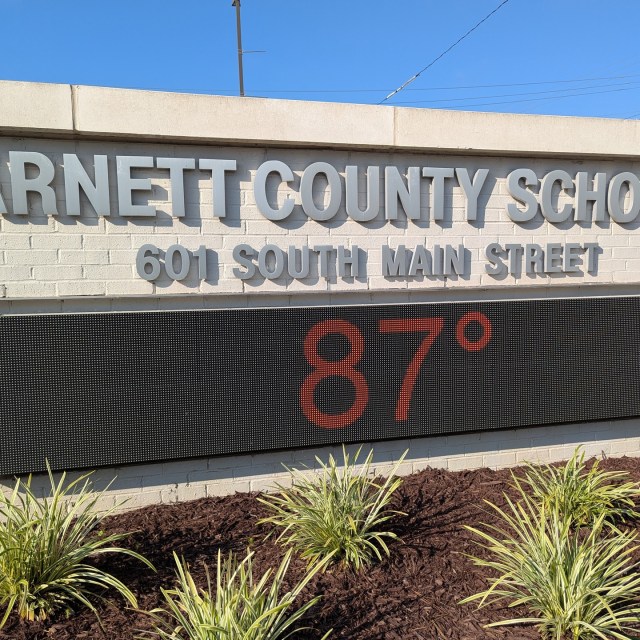
At the May 18 budget hearing, the Harnett County Board of Commissioners debated school funding priorities, nonprofit appropriations and public safety spending while preparing for potential statewide property tax restrictions under House Bill 1089.
Chairman Duncan Jaggers warned the proposed FY2026-27 budget could face new legislative limits on local property tax levy growth, while County Manager Brent Trout said the county had funding available to support school requests.
Commissioners reviewed multiple budget options, balancing school construction funding, nonprofit reductions and public safety spending, including proposed investments in emergency services, county security weapon detectors and industrial development.
Public comments reflected concerns over nonprofit appropriations, law enforcement spending, property tax appeals and a newly approved county chatbot service intended to reduce routine customer service, of which is fifteen inquires per month.
The proposed budget sets a 59.1-cent tax rate per $100 valuation, allocates the largest portions of property tax revenue to public safety, education and human services, and includes expanded school appropriations amid continued growth pressures and rising property assessment appeals across the county.

On May 19, Democrat Governor Stein signed an executive order to increase housing opportunities and affordability for all North Carolinians. Executive Order No. 36 directs cabinet agencies to work together to increase housing supply, affordability, and access and to use technology to deliver data-driven solutions.

At the May 19 Sanford City Council meeting, the Oakton mixed-use development, featuring 473 homes and commercial space, was heavily discussed regarding its role as a potential “Gateway to the City” near the highway interchange. Representatives for D.R. Horton said the 111-acre project would include luxury-style homes, townhomes, apartments and retail space, while council members questioned highway noise, buffers and long-term aesthetics. The applicant will return in June with renderings showing how the development would appear from the highway.
Concerns also continued over school capacity, as the project would feed into schools already nearing enrollment limits.

It is important to note that Lee County School Chairperson Sherry Womack introduced a resolution for the county and city to collaborate with the school district to achieve capacity standards. Review the resolution here.
Citizens may want to contact their representatives to request legislation for school capacity and development, such as House Bill 1119.
Separate rezoning proposals for the Broadwell Conditional Zoning District and Landmark Towing of Sanford Inc. advanced despite concerns about rapid growth and rural land-use changes.
Broadwell would add hundreds of additional homes and townhomes in the Jonesboro district, while the Landmark request would rezone countryside property from residential to light industrial use along Broadway Road, raising concerns from some observers that continued rezonings will gradually transform rural corridors into commercial and industrial areas.

The Sanford City Council honored Dr. Charles Alexander at the May 19 meeting with a key to the city and a surprise proclamation.
“I thought I was here to take a proclamation to Raleigh,” Alexander said after the meeting. “It was a surprise.”
Alexander had a planned trip to Raleigh to deliver a proclamation on behalf of older citizens to the North Carolina Senior Tarheel Legislature. “I am a delegate from Lee County to the Central Pines Regional Council on aging and represent Tarheel.”
Mayor Rebecca Salmon handed Alexander a proclamation to honor his 32 years of public education, volunteerism, senior enrichment activism, and Kiwanis membership.

Moore County commissioners supported the property tax cap legislation while residents warned the proposal could strain long-term funding for schools, emergency services and growth-related infrastructure amid rising development pressures.
At the May 19 meeting of the Moore County Board of Commissioners, debate centered on North Carolina House Bills 1089 and 1042, the county’s proposed FY 2026-27 budget and concerns over growth management.
Resident John Misiaszek criticized the board’s support of HB 1089, arguing limits on property tax levies could weaken future funding for schools, public safety and infrastructure as Moore County continues rapid development and rising property values.
Chairman Nick Picerno defended the proposal as protection against unchecked taxation and said the government should not rely on increasing property taxes.
Picerno writes in an email, “Restricting property taxes does not in itself weaken county finances. If other revenues such as sales taxes exceed the so called restrictions in property tax then the county will actually have a stronger financial position.”
The proposed $239 million budget lowers the general fund tax rate while increasing the ALS rate for emergency services, with county leaders emphasizing diversified revenues, tourism taxes and rising property valuations as reasons Moore County maintains a comparatively low levy.
Commissioners also addressed concerns about agricultural building restrictions in the Uniform Development Ordinance, with Picerno directing planners to change regulations.
As “Quicksand: no legislation for development approval and school capacity” directs, citizens may want to contact their representatives to request legislation for school capacity and development, such as House Bill 1119. When developers, counties, cities and schools are forced by law to collaborate, the financial burden can be reduced and school overcapacity problems can be prevented. Review the Moore County Schools’ capacity charts below.
Moore County Schools has two high schools at overcapacity: Pinecrest with 644 over and Union Pines with 380.
The Area I table was provided by the public information officer and updated using 2024-2025 school year data and was briefed as part of the planning work associated with the new Carthage Elementary School project. The Area II and Area III tables were developed using 2022-2023 school year data and were included in a presentation provided to the Board of Education in October 2022. Those two areas have not yet been updated.
The original Area I table from the October 2022 presentation was crossed out within the attachment (page 2) to distinguish it from the updated 2024-2025 Area I table (page 1).


Lee County School Chairperson Sherry Womack’s board passed her “RESOLUTION REGARDING RESIDENTIAL GROWTH, SCHOOL CAPACITY, AND INTERGOVERNMENTAL COORDINATION” this week. View here.
Moore County dedicates “Sales Tax Article 46” to school construction debt, but those revenues fluctuate with economic conditions and retail activity.

Rising construction costs and inflexible property taxes could hinder school funding.
“Governor Stein signed an executive order for more affordable housing” this week, which may create a growth phase that stimulates construction funding. The issue is meeting demand because increasing minimum wage has not been announced. Another concern is that a plentiful housing market may lower prices, and that would result in lower real estate sales taxes, which are used to fund school construction.
With tax constraints, departments like parks and arts could be scrutinized before schools or emergency services are affected.
For now, Moore County is on a healthy track, with low rates from higher revenue growth.
Enjoy the Teen News video!
https://www.youtube.com/shorts/jsGiVzYl2Wc
May 22, 2026
Stephanie M. Sellers
Subscribe to Sandhills News and support this conservative flagship journalism with advertising.
Submit news tips, events and interview requests to editor@sandhills.news.
Sandhills News is plain-English local government reporting that explains how decisions affect your land, taxes, schools and rights.


Subscribe to get the latest posts sent to your email.









 Sylvan Learning of Southern Pines NC is the investment you make for your child's sake. Education. https://sandhills.news/2025/12/07/sylvan-learning-of-southern-pines/9 months ago

 You can also follow on Instagram to see more.
Follow Sandhills News on Facebook and Instagram to learn the latest in Moore, Lee and Harnett.
We cover family-friendly news.10 months ago
Sandhills News will cover Five Points Horse Trials – Treehouse Event Series Championships today!
Carolina Horse Park, 2814, Montrose Road, Raeford, NC
Carolina Horse Park serves cross country, dressage, jumping and classes with a side of green biscuits from Sept. 5 through Sept. 7.
Love horses? This is where you can enjoy the show and the ambiance equestrians recognize as energy in the air when eventers pass by and revel in their accomplishments and neighs sound another moment of glory—unless they lose. In which case, barn language ensues.
Read the full schedule, plan your days and enjoy! Carolina Horse Park schedule for Sept. 5-7.
Food trucks will be on-site.1 year ago
Moore County Commissioners approve infrastructure upgrades in Pinehurst after Tropical Storm Chantal closed 13 roads and busted a dam in other towns in Moore County. https://sandhills.news/2025/07/16/moore-county-eyes-flooding-solutions-and-approves-1-2m-for-school-turf-projects-as-schools-face-budgets-cuts/1 year ago
Moore, Lee, and Harnett NC opioid settlement funds did not consider residential treatment for women. https://sandhills.news/2025/07/13/sandhills-opioid-funding-misses-the-mark-for-residential-treatment/1 year ago
You can also follow on Instagram to see more.
Follow Sandhills News on Facebook and Instagram to learn the latest in Moore, Lee and Harnett.
We cover family-friendly news.10 months ago
Sandhills News will cover Five Points Horse Trials – Treehouse Event Series Championships today!
Carolina Horse Park, 2814, Montrose Road, Raeford, NC
Carolina Horse Park serves cross country, dressage, jumping and classes with a side of green biscuits from Sept. 5 through Sept. 7.
Love horses? This is where you can enjoy the show and the ambiance equestrians recognize as energy in the air when eventers pass by and revel in their accomplishments and neighs sound another moment of glory—unless they lose. In which case, barn language ensues.
Read the full schedule, plan your days and enjoy! Carolina Horse Park schedule for Sept. 5-7.
Food trucks will be on-site.1 year ago
Moore County Commissioners approve infrastructure upgrades in Pinehurst after Tropical Storm Chantal closed 13 roads and busted a dam in other towns in Moore County. https://sandhills.news/2025/07/16/moore-county-eyes-flooding-solutions-and-approves-1-2m-for-school-turf-projects-as-schools-face-budgets-cuts/1 year ago
Moore, Lee, and Harnett NC opioid settlement funds did not consider residential treatment for women. https://sandhills.news/2025/07/13/sandhills-opioid-funding-misses-the-mark-for-residential-treatment/1 year ago Harnett County Schools seek community support for student service-learning projects.
https://sandhills.news/2025/07/12/harnett-schools-service-learning-program-invites-community-support/1 year ago
Harnett County Schools seek community support for student service-learning projects.
https://sandhills.news/2025/07/12/harnett-schools-service-learning-program-invites-community-support/1 year ago Angier is home to the Corner Grill and locals who know where to find HOMEMADE food!
https://sandhills.news/2025/07/12/locals-crave-the-corner-grills-chicken-salad-sandwich-and-cheesburgers/1 year ago
Angier is home to the Corner Grill and locals who know where to find HOMEMADE food!
https://sandhills.news/2025/07/12/locals-crave-the-corner-grills-chicken-salad-sandwich-and-cheesburgers/1 year ago Fred Lee IV wows the crowd at Kiwanis Park in Sanford, NC.
Book him for your next event.
https://sandhills.news/2025/07/14/fred-lee-iv-wins-the-crowd-at-kiwanis-park/1 year ago
Sandhills News loved the bagpipes in the 4 July 2025 Village of Pinehurst Parade!
See all the photos.
https://sandhills.news/2025/07/05/moore-pinehurst-and-whispering-pines-parades-highlight-community-spirit/1 year ago
Fred Lee IV wows the crowd at Kiwanis Park in Sanford, NC.
Book him for your next event.
https://sandhills.news/2025/07/14/fred-lee-iv-wins-the-crowd-at-kiwanis-park/1 year ago
Sandhills News loved the bagpipes in the 4 July 2025 Village of Pinehurst Parade!
See all the photos.
https://sandhills.news/2025/07/05/moore-pinehurst-and-whispering-pines-parades-highlight-community-spirit/1 year ago


