
Harnett County to review 322-home major subdivision proposal
June 16, 2026


Balanced. Honest. Family-friendly.

 Karmelo Anthony: expendable race bait
June 14, 2026
Karmelo Anthony: expendable race bait
June 14, 2026
 Wisdom from a time traveler: AI lessons from the planet Tralfamadore
May 31, 2026
Wisdom from a time traveler: AI lessons from the planet Tralfamadore
May 31, 2026
 Are legislative gaps responsible for rapid growth issues?
May 31, 2026
Are legislative gaps responsible for rapid growth issues?
May 31, 2026

It is time to bite the lemon, the school budget lemon. Make that “lemons” because over the next ten years, lemons and their seeds will flavor sweet tea like new developments dot landscapes.
The beginning of the 2025-26 school year revealed escalating student populations, teacher shortages, funding gaps and crowded schools across the tri-county area. While counties and municipalities allow increasing development in already stressed school districts, and the North Carolina General Assembly decides on passing House Bill 765 that steals the people’s voices on deciding where to develop.
People complain about development, but according to research, and the “build it and they will come” attitude profiting developers, people will be rolling in from other areas into North Carolina, so school districts need to prepare.
Dr. Michael Cline, North Carolina’s state demographer, projects the state’s population will reach 11.7 million by 2030, enough to add an additional congressional seat after the 2030 Census. North Carolina is also expected to surpass Georgia and Ohio to become the seventh-largest state in the nation in the early 2030s.
By 2050, the state’s population is projected to grow to 14.2 million, an increase of 3.8 million since 2020. Cline outlined seven key trends in his analysis of these projections. View them here.
Lee County is projected to see nearly 10,000 residents by 2035, according to the North Carolina Office of State Budget and Management. The county’s population is expected to climb from about 70,000 in 2025 to nearly 80,000 in 2035. That growth is expected to bring an additional 1,500 to 1,800 school-age children into the district.
The added enrollment would require one to two new schools, depending on grade level distribution. A standard elementary school in North Carolina serves about 850 students, while middle schools average around 1,000 seats and high schools range from 1,600 to 1,800.
Lee County Schools’ capital improvement plan anticipates this pressure. The district is scheduled to build an 850-seat elementary school by fiscal year 2029 and purchase land for a future campus that could hold both an elementary and middle school.
Lee County Schools Operation Committee met Aug. 26 in closed session with Matthew Palmer’s North Carolina State University Operations Research and Education Laboratory team on Aug. 26.
After the meeting, the committee said it will present plans for a needs-based grant for a new elementary school to county commissioners in the next months.
Lee County Schools flagged the need for additional middle school capacity after 2030, with high school expansions, or the possibility of a new high school identified as a longer-term priority.
Lee County is well positioned to support new school construction and student costs with industrial and commercial taxes picking up the deficit from lower-priced housing.
To cover the cost of one student for a school year, not the cost of building a school, a school district in the tri-county area needs the property taxes of one $450,000 evaluated property. Most single-family homes in Lee County are valued at around $300,000.
Moore County’s population is expected to climb from about 110,000 in 2025 to 148,500 by 2040.
High schools are especially overcrowded, with Pinecrest and Union Pines each enrolling hundreds more students than their designed capacities and relying on mobile classrooms to make up the difference.
The school board estimates renovations around $245 million, while building a new 1,400–to–1,700-student high school may cost between $150 and $310 million. Middle schools are also under pressure: West Pine Middle School could reach an enrollment of 1,161 by 2028, above its 700-student capacity.
Moore County will likely need to construct at least one new high school and one new middle school over the next decade, and potentially one or more elementary schools.
Harnett County’s total population is expected to increase with around 25,000 arriving in the upcoming decade. Statewide patterns suggest K–12 enrollment may remain stable through 2030 before accelerating, and Harnett’s shift to a regional center and suburban status signals increasing demand.
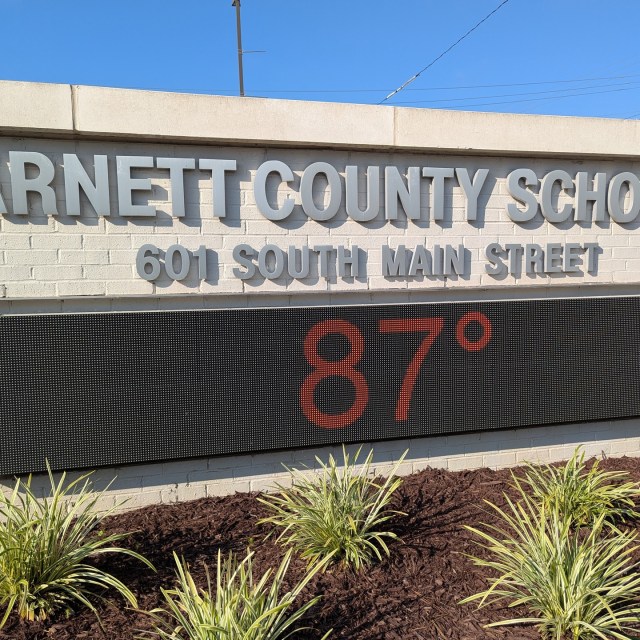
In the 2025-26 school year, about 20,032 students are enrolled across 28 Harnett County Schools.
Harnett Central Middle School exceeded capacity and is projected to reach nearly 1,800 students within eight years, while Overhills Middle is also approaching capacity. To address this, the school system has greenlit construction of Flatwoods Middle School, a new facility for 1,100 students, budgeted at $78 million.
Given the county’s growing population, one new elementary school will likely be required to keep pace with demographic shifts, and high school capacity may need to be expanded later in the decade. Overall, planning suggests the need for at least two new schools, one middle and one elementary, with high-school expansion to accommodate projected growth.
How many lemonade stands does each county need to open to fund new schools?
For Lee County to accommodate 1,800 additional students, the district would need the equivalent of one elementary and one middle school over the next ten years. At current market rates, an elementary school costs $25 million to $45 million and a middle school costs $30 million to $60 million, putting Lee’s total new-school cost in the range of about $55 million to $105 million.
Moore County needs a new high school for about 1,700 students plus at least one middle and one elementary at about $150 million to $310 million. Adding a middle school for about $60 million and an elementary school adds up to $205 million to $415 million. If the district opts for renovation instead of new construction, the costs could be in the low-to-mid hundreds of millions as an alternative.
Harnett County has already budgeted and approved construction of Flatwoods Middle School with 1,100 seats and costs at about $78 million to $95 million. To fully meet projected growth through the decade, officials may add one new elementary school at $25 million to $45 million and may need high-school capacity expansions later. If the county builds a new high school later, add $150 million to $310 million, bringing a three-school total to roughly $253 million to $433 million.
School construction costs were based on current averages without land purchases or utilities and the sources listed below.
At this rate, people might need more than a few lemonade stands, unless, of course, the kids start charging $10 a cup with free refills of irony.
Aug. 27, 2025
Stephanie M. Sellers
https://www.osbm.nc.gov/facts-figures/population-demographics/state-demographer/countystate-population-projections/population-overview
https://www.census.gov/quickfacts/fact/table/moorecountynorthcarolina
https://carolinademography.cpc.unc.edu/2024/01/23/nc-to-become-7th-most-populated-state-in-early-2030s
https://www.dpi.nc.gov/documents/schoolplanning/school-costs-year
https://www.harnett.org/budget/downloads/totalapprovedcip.pdf
https://www.bdcnetwork.com/home/news/55165792/k-12-school-construction-costs-for-2024
https://jocoreport.com/harnett-county-oks-plans-for-new-school
https://www.ncruralcenter.org/county-data/harnett
https://www.lee.k12.nc.us/page/thrive-in-lee/
https://cdnsm5-ss10.sharpschool.com/UserFiles/Servers/Server_19566293/File/Leadership/Strategic%20Plan/APPROVED%202025-2027%20MCS%20Strategic%20Plan%206.9.2025.pdf


Subscribe to get the latest posts sent to your email.









 Sylvan Learning of Southern Pines NC is the investment you make for your child's sake. Education. https://sandhills.news/2025/12/07/sylvan-learning-of-southern-pines/6 months ago

 You can also follow on Instagram to see more.
Follow Sandhills News on Facebook and Instagram to learn the latest in Moore, Lee and Harnett.
We cover family-friendly news.7 months ago
Sandhills News will cover Five Points Horse Trials – Treehouse Event Series Championships today!
Carolina Horse Park, 2814, Montrose Road, Raeford, NC
Carolina Horse Park serves cross country, dressage, jumping and classes with a side of green biscuits from Sept. 5 through Sept. 7.
Love horses? This is where you can enjoy the show and the ambiance equestrians recognize as energy in the air when eventers pass by and revel in their accomplishments and neighs sound another moment of glory—unless they lose. In which case, barn language ensues.
Read the full schedule, plan your days and enjoy! Carolina Horse Park schedule for Sept. 5-7.
Food trucks will be on-site.9 months ago
Moore County Commissioners approve infrastructure upgrades in Pinehurst after Tropical Storm Chantal closed 13 roads and busted a dam in other towns in Moore County. https://sandhills.news/2025/07/16/moore-county-eyes-flooding-solutions-and-approves-1-2m-for-school-turf-projects-as-schools-face-budgets-cuts/11 months ago
Moore, Lee, and Harnett NC opioid settlement funds did not consider residential treatment for women. https://sandhills.news/2025/07/13/sandhills-opioid-funding-misses-the-mark-for-residential-treatment/11 months ago
You can also follow on Instagram to see more.
Follow Sandhills News on Facebook and Instagram to learn the latest in Moore, Lee and Harnett.
We cover family-friendly news.7 months ago
Sandhills News will cover Five Points Horse Trials – Treehouse Event Series Championships today!
Carolina Horse Park, 2814, Montrose Road, Raeford, NC
Carolina Horse Park serves cross country, dressage, jumping and classes with a side of green biscuits from Sept. 5 through Sept. 7.
Love horses? This is where you can enjoy the show and the ambiance equestrians recognize as energy in the air when eventers pass by and revel in their accomplishments and neighs sound another moment of glory—unless they lose. In which case, barn language ensues.
Read the full schedule, plan your days and enjoy! Carolina Horse Park schedule for Sept. 5-7.
Food trucks will be on-site.9 months ago
Moore County Commissioners approve infrastructure upgrades in Pinehurst after Tropical Storm Chantal closed 13 roads and busted a dam in other towns in Moore County. https://sandhills.news/2025/07/16/moore-county-eyes-flooding-solutions-and-approves-1-2m-for-school-turf-projects-as-schools-face-budgets-cuts/11 months ago
Moore, Lee, and Harnett NC opioid settlement funds did not consider residential treatment for women. https://sandhills.news/2025/07/13/sandhills-opioid-funding-misses-the-mark-for-residential-treatment/11 months ago Harnett County Schools seek community support for student service-learning projects.
https://sandhills.news/2025/07/12/harnett-schools-service-learning-program-invites-community-support/11 months ago
Harnett County Schools seek community support for student service-learning projects.
https://sandhills.news/2025/07/12/harnett-schools-service-learning-program-invites-community-support/11 months ago Angier is home to the Corner Grill and locals who know where to find HOMEMADE food!
https://sandhills.news/2025/07/12/locals-crave-the-corner-grills-chicken-salad-sandwich-and-cheesburgers/11 months ago
Angier is home to the Corner Grill and locals who know where to find HOMEMADE food!
https://sandhills.news/2025/07/12/locals-crave-the-corner-grills-chicken-salad-sandwich-and-cheesburgers/11 months ago Fred Lee IV wows the crowd at Kiwanis Park in Sanford, NC.
Book him for your next event.
https://sandhills.news/2025/07/14/fred-lee-iv-wins-the-crowd-at-kiwanis-park/11 months ago
Sandhills News loved the bagpipes in the 4 July 2025 Village of Pinehurst Parade!
See all the photos.
https://sandhills.news/2025/07/05/moore-pinehurst-and-whispering-pines-parades-highlight-community-spirit/12 months ago
Fred Lee IV wows the crowd at Kiwanis Park in Sanford, NC.
Book him for your next event.
https://sandhills.news/2025/07/14/fred-lee-iv-wins-the-crowd-at-kiwanis-park/11 months ago
Sandhills News loved the bagpipes in the 4 July 2025 Village of Pinehurst Parade!
See all the photos.
https://sandhills.news/2025/07/05/moore-pinehurst-and-whispering-pines-parades-highlight-community-spirit/12 months ago


