Spend more, learn less: the promise of public education
November 29, 2026


Balanced. Honest. Family-friendly.

 John Misiaszek challenges Lee County data center tax analysis, questions electricity tax revenue
November 24, 2026
 Lee County data center: the true meaning of the tax promise
November 24, 2026
 “What is a woman?” A warship? A table? Or a Dos Equis (XX) beer?
November 22, 2026
Robert M. Levy

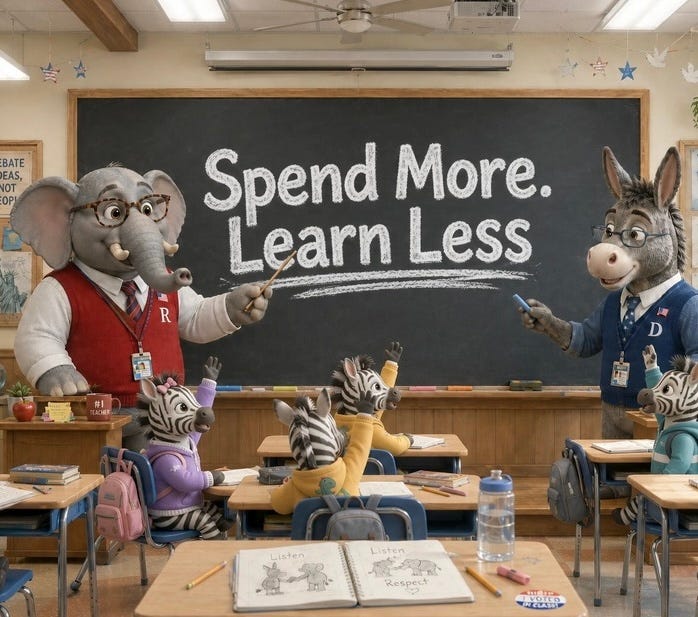
Yeah, public education is in trouble. Test scores are going down. Costs are going up. Many parents fear that their children will not receive a good education. So this past November, many people fell for the Democrat mantra, “We need to fully fund education.” It was a fraud. But so was the Republican line before that. Neither side understands. In education, money and outcome have a negative relationship.
In my home state of North Carolina as well as elsewhere in the United States, education is actually OVER-FUNDED. Schools are “drowning in money.” Yet children are achieving less year after year.
For Academic Year 2025-2026, 57.2% of North Carolina’s general revenue went to education, almost $6 for every $10 the state collected. To that, we add that an average of 35% of North Carolina county budgets dedicated to schools and community colleges. Then, the “feds” “put a cherry on top.” They underwrite 17.7% of all Tar Heel K-12 academic instruction. That does not even include the full federal funding of school breakfasts and lunches.

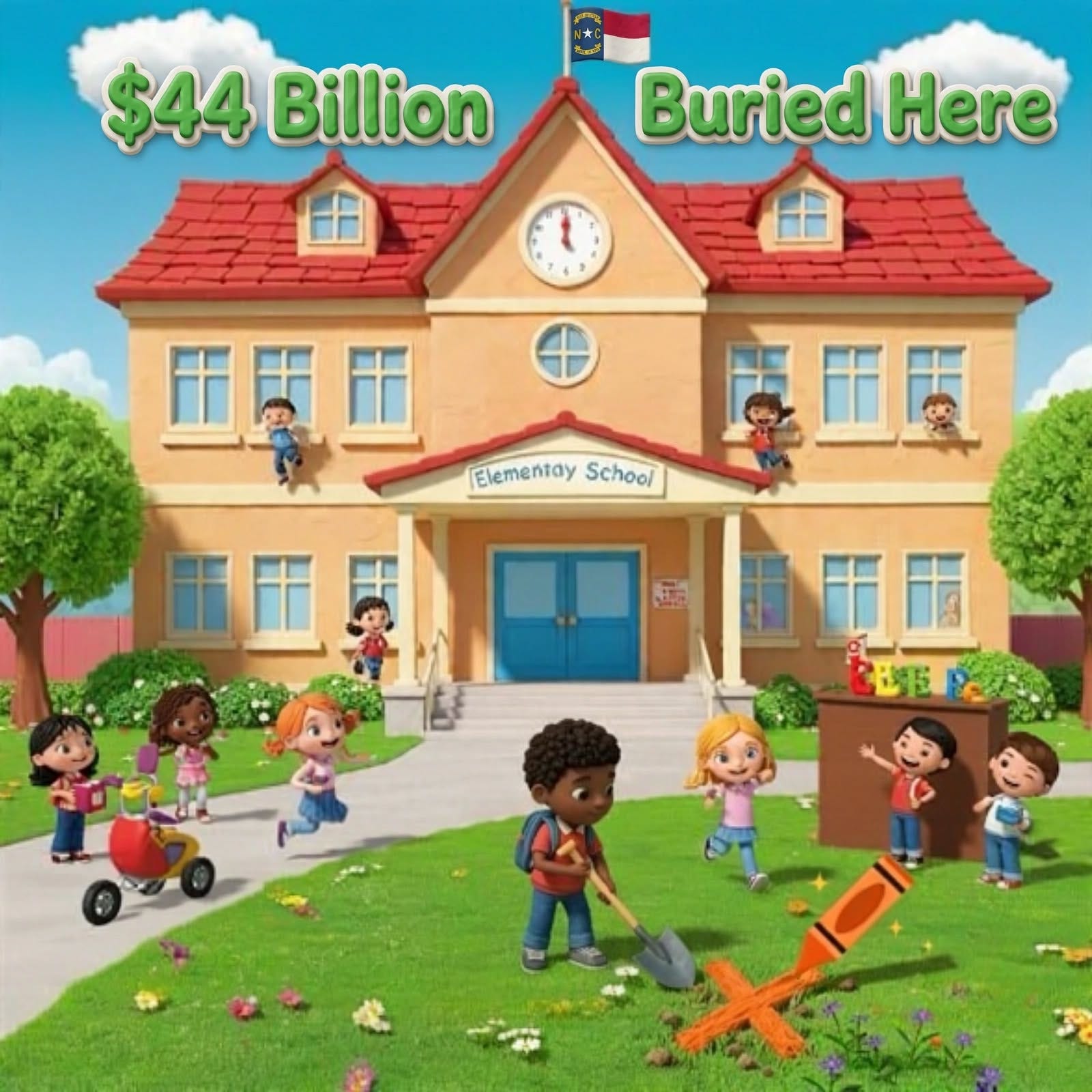
As an industry, K-12 education in North Carolina, both public and charter, generates and spends about $20 billion per year. To that, we can add $24 billion for state colleges and universities. In short, in my home state of North Carolina, education is a $44 billion government business.
By contrast, the North Carolina based business which generated the largest amount of annual state revenue last year was Hendrick Automotive Group. Yeah, they’re the people who gave you a great price on your new Jeep but talked you into taking a useless warranty. They generated about $14 billion in 2025. Just below. Hendrick (but uncertain because of lack of full data) is Epic Games of Cary, the maker of Fortnite.
Nationally, Epic supposedly earned about $7 billion last year. So the “North Carolina Education Company,” a “state owned enterprise” with its $44 billion in “revenue,” dwarfs every private company in the state.

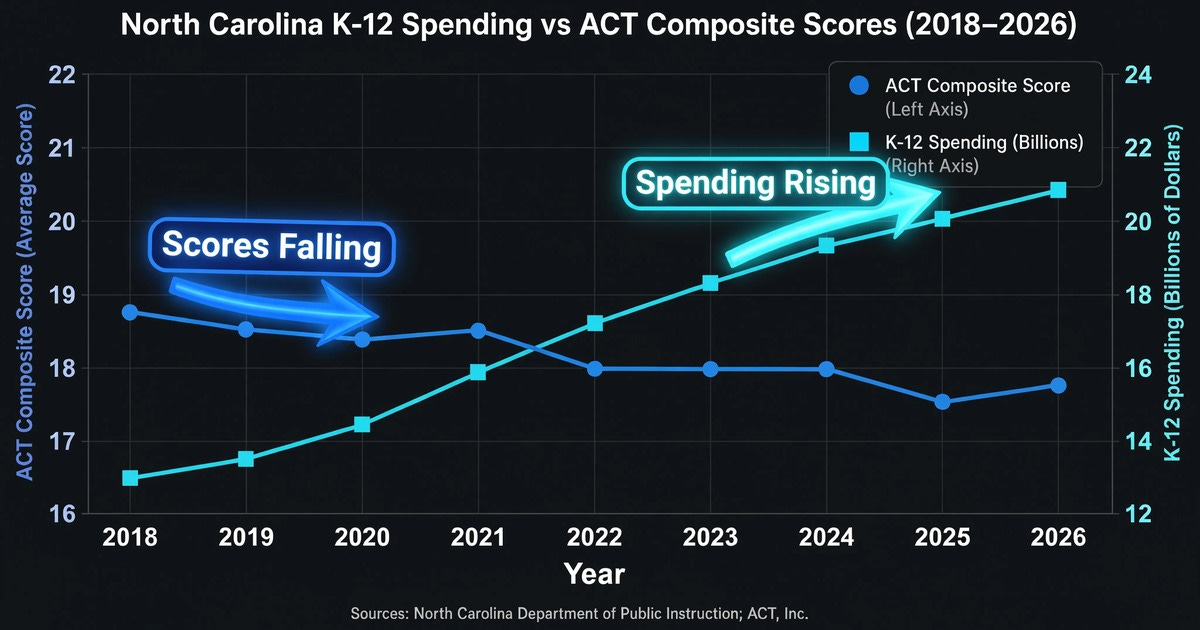
Okay. “What do the taxpayers get for all that money?” In 2019, North Carolina appropriated $15.2 billion to “teach the kids their lessons.” In that year, North Carolina high school students achieved a composite ACT (American College of Testing) score of 19.1. By 2025, Tar Heel K-12 education spending gradually rose to $22 billion. Still, composite scores fell to 18.3. In other words, in those six years between 2019 and 2025, education appropriations (not including Covid funds) rose by 69%. But year over year, ACT scores fell. The chart below shows that. The numbers generate an almost perfect negative correlation coefficient of -.95. Perfect is -1.0.

Now, we should not “quibble” just because the correlation is not “perfect”. 95 is an A. Our politicians, both Democrats and Republicans, earned that A by spending more so that kids could learn less.
So “Qui bono?” Who profited? Who got the benefit of the 69% rise in education spending? It wasn’t the teachers. In North Carolina between 2019 and 2026, teacher pay rose about 11.2.%. Meanwhile, for the Southeastern region of the United States, inflation rose 31.5%. While spending for education rose over double the rate of inflation, the teachers who are responsible for education took a pay cut of 20% in terms of real spendable income.
Let’s put it plainly. For those who prefer Latin over English, for the past seven years or over the past “septenneum,” in North Carolina, students, teachers and taxpayers got “screwed.”

Nor will the trend abate as Democrats add their conquest of the State House of Representatives to their takeover of the governorship, the State Board of Education and the Superintendent of Public Instruction. The Democrat solution to the fall of educational achievement is to spend more and more money. We tried that. It didn’t work. And it doesn’t take an Einstein to know that a failed solution won’t work, no matter how many times it’s tried.
And oh yeah, one more thing: The Democrats plan to greatly reduce or eliminate the availability of vouchers, scholarships, and other funding for private school students. Currently, private schools spend an average of $11,632 per pupil per year. Public schools spend about $13,200. If the Democrats effectively control North Carolina education, per pupil K-12 education cost will go up at least 12% for those who, for lack of a voucher, will be forced out of private schooling.
Meanwhile, educational achievement will continue to fall as this change will, at best, do nothing for academic performance. At worst, by removing children from small, comfortable private school environments and placing them into an often overwhelming public school environment, academics will further suffer.

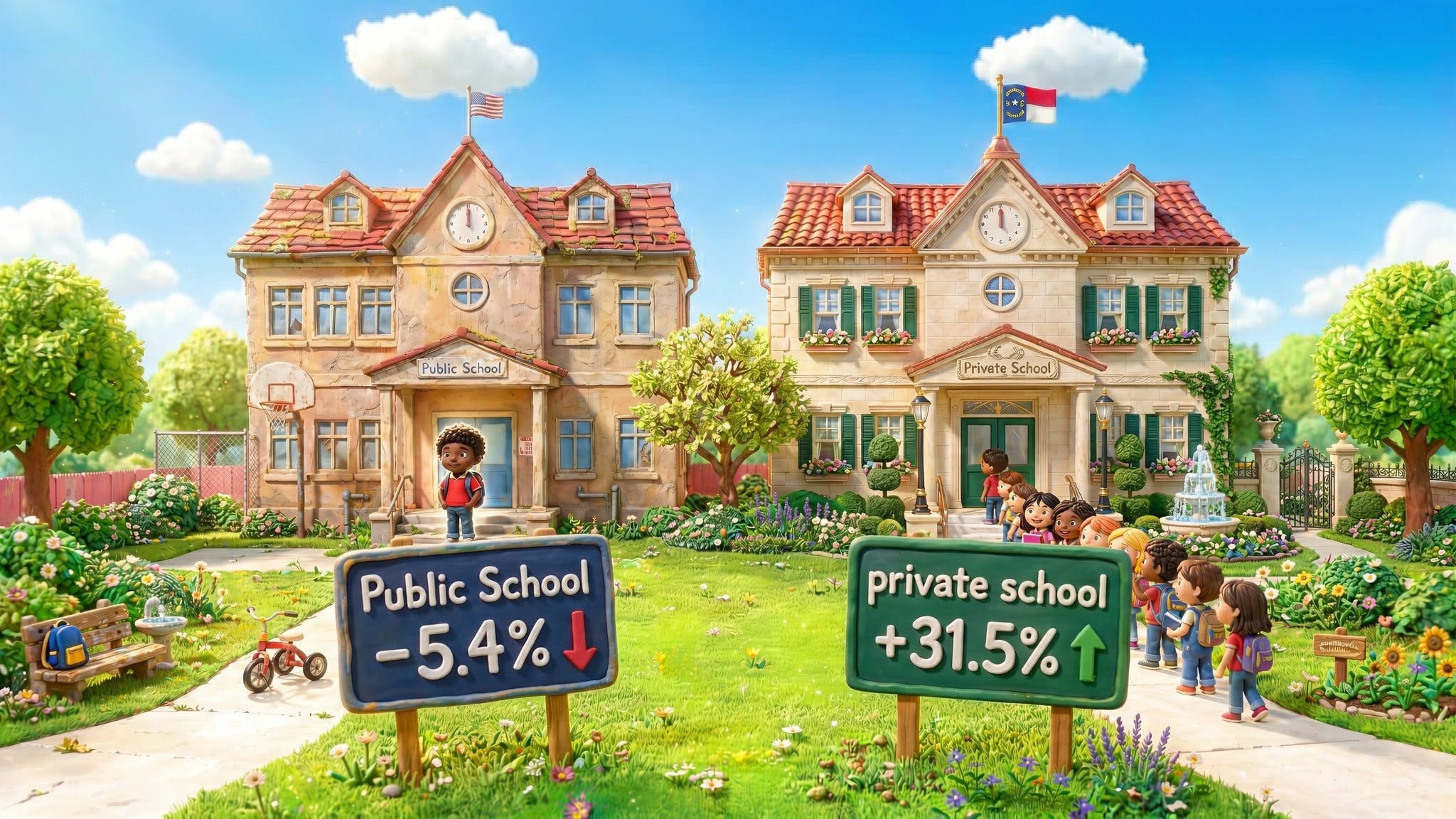
Parents also understand that there is a problem with public education. They act accordingly. Between 2019 and 2026, private school enrollment in North Carolina rose 31.5%. At the same time, traditional public-school enrollment fell 5.4%. And even when publicly funded charter schools are taken into consideration, the year-over-year change in public school attendance is flat.
With Democrats in charge, the reality of public schools will be to trap more children, especially poor and overwhelmingly minority children, in an educational program which, year after year, achieves less after less.

It is about time that Democrats and Republicans find a way to increase student achievement without just “throwing money at the problem.” Both sides need to ask what private schools are doing to make them so popular? First and foremost, that popularity needs to be replicated rather than eradicated.
The Democrat solution to the popularity of less expensive private schooling is to defund it and outlaw what’s left. It’s time for a new path. It’s time for Democrats and Republicans to join that new path.
First, legislate less. Allow the teachers to teach more and pay them better for what they teach. Yet keep appropriations constant. There is plenty of fat and waste in a program that consumes well over 57% of the state budget.

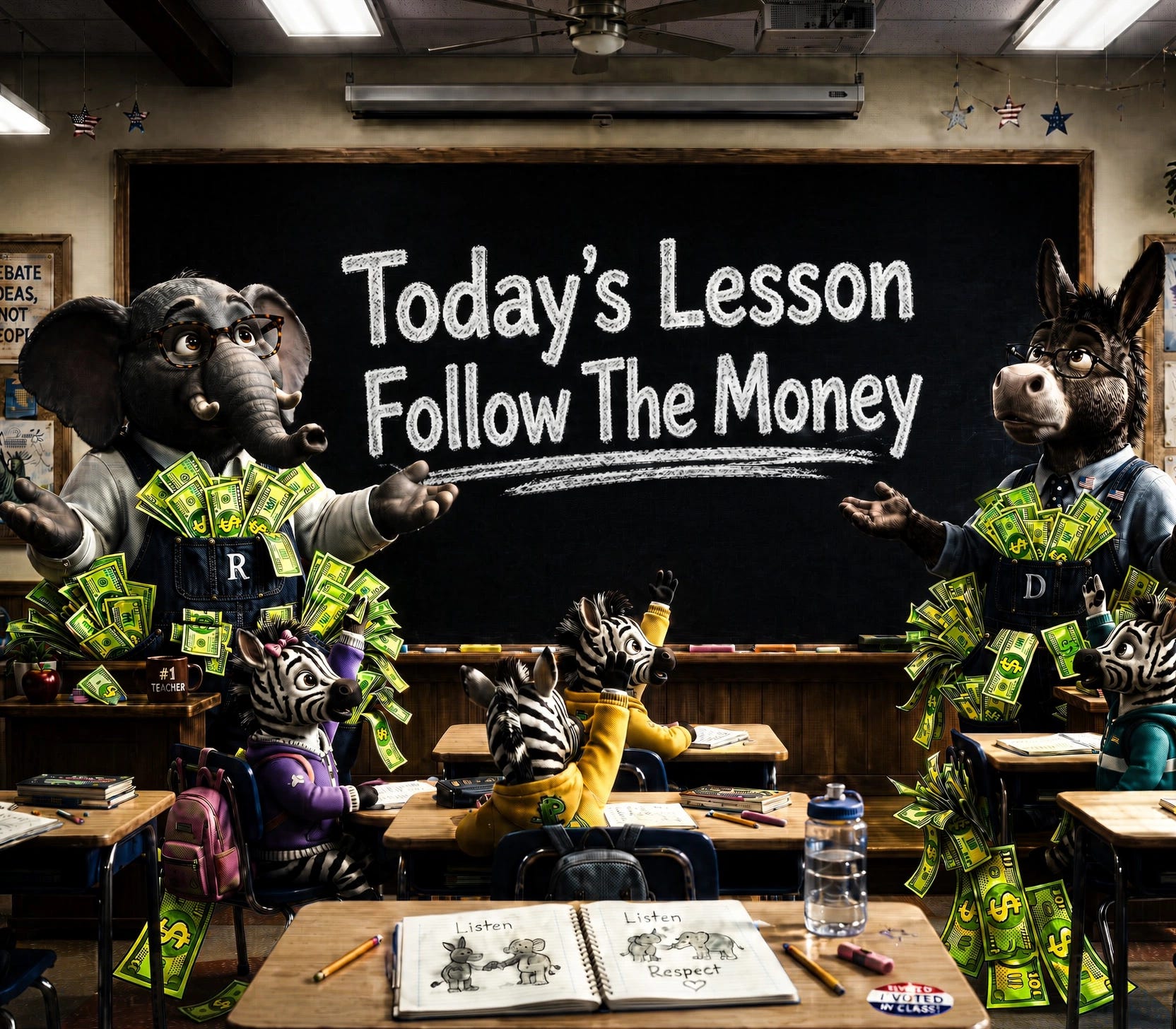
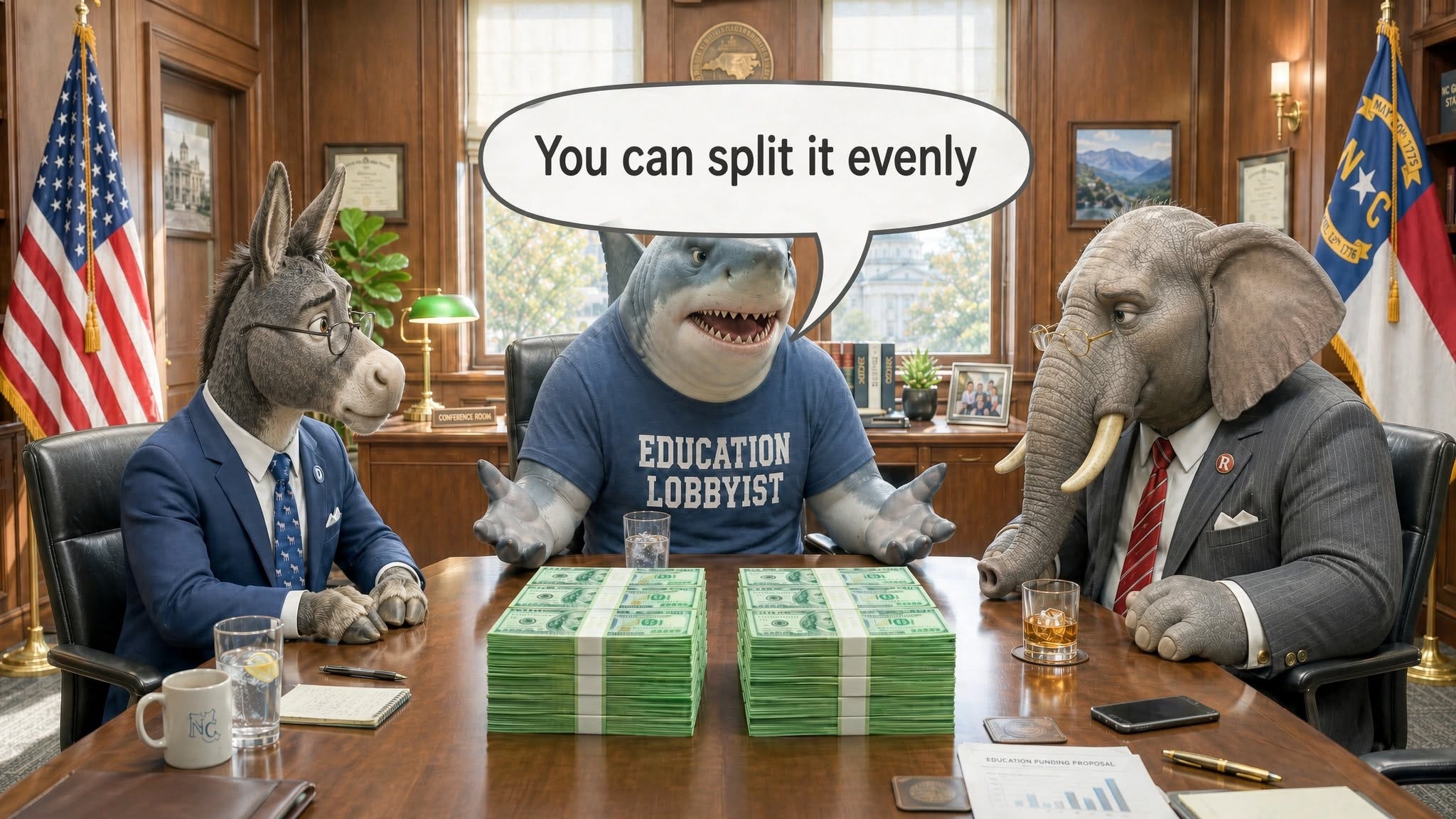
It’s not complicated. “Kick to the curb” the greedy parasites who sell schools overpriced goods and services. They see children mostly as the raw material from which they extract profit. They mire us all in a cesspool of political contributions classified as “necessary business expenses”.
Before appropriating any more money for any education program, both Republicans and Democrats should ask, “Will this appropriation raise the academic proficiency of our students?” Unless this question is answered in the affirmative, the program should not be funded. Moreover, any program that fails to meet this test should be defunded. The resulting savings should be enough to raise teachers’ salaries and reverse the decline in public education.

Nov. 29, 2026
Robert M. Levy
Robert M. Levy grew up in Moore County and graduated from Pinecrest High School. He earned a BA in history and sociology from the University of North Carolina at Chapel Hill, where his honors thesis on the Wilmington Rebellion of 1898 became part of the university’s library collection.
Admitted to the California State Bar in 1978, Levy practiced law for 40 years in California and Maryland, focusing on family and criminal law, including work with juvenile offenders and abused children. His writing on affirmative action appeared in the San Fernando Valley Law Review, and he authored Divorce: A Cynical Experience. He later earned a North Carolina teaching certificate from UNC Charlotte and taught high school social studies across Moore County.
Levy has served as chairman of the Moore County School Board, president of the North Carolina Electoral College, chairman of the Moore County Republican Party, and a columnist for The Pilot in Southern Pines. He lives in Pinehurst with his wife, Linda, and they have three children and four grandchildren.
Want to submit an editorial for consideration? If you level up with Robert Levy’s quality, send your bio and proposal to editor@sandhills.news.
Subscribe to Sandhills News and support this conservative journalism with advertising.
Submit news tips, events and interview requests to editor@sandhills.news.
Sandhills News is plain-English local government reporting that explains how decisions affect your land, taxes, schools and rights.

Subscribe to get the latest posts sent to your email.









 Sylvan Learning of Southern Pines NC is the investment you make for your child's sake. Education. https://sandhills.news/2025/12/07/sylvan-learning-of-southern-pines/12 months ago


 You can also follow on Instagram to see more.
Follow Sandhills News on Facebook and Instagram to learn the latest in Moore, Lee and Harnett.
We cover family-friendly news.1 year ago
Sandhills News will cover Five Points Horse Trials – Treehouse Event Series Championships today!
Carolina Horse Park, 2814, Montrose Road, Raeford, NC
Carolina Horse Park serves cross country, dressage, jumping and classes with a side of green biscuits from Sept. 5 through Sept. 7.
Love horses? This is where you can enjoy the show and the ambiance equestrians recognize as energy in the air when eventers pass by and revel in their accomplishments and neighs sound another moment of glory—unless they lose. In which case, barn language ensues.
Read the full schedule, plan your days and enjoy! Carolina Horse Park schedule for Sept. 5-7.
Food trucks will be on-site.1 year ago
Moore County Commissioners approve infrastructure upgrades in Pinehurst after Tropical Storm Chantal closed 13 roads and busted a dam in other towns in Moore County. https://sandhills.news/2025/07/16/moore-county-eyes-flooding-solutions-and-approves-1-2m-for-school-turf-projects-as-schools-face-budgets-cuts/1 year ago
Moore, Lee, and Harnett NC opioid settlement funds did not consider residential treatment for women. https://sandhills.news/2025/07/13/sandhills-opioid-funding-misses-the-mark-for-residential-treatment/1 year ago
 Harnett County Schools seek community support for student service-learning projects.
https://sandhills.news/2025/07/12/harnett-schools-service-learning-program-invites-community-support/1 year ago
 Angier is home to the Corner Grill and locals who know where to find HOMEMADE food!
https://sandhills.news/2025/07/12/locals-crave-the-corner-grills-chicken-salad-sandwich-and-cheesburgers/1 year ago
 Fred Lee IV wows the crowd at Kiwanis Park in Sanford, NC.
Book him for your next event.
https://sandhills.news/2025/07/14/fred-lee-iv-wins-the-crowd-at-kiwanis-park/1 year ago
Sandhills News loved the bagpipes in the 4 July 2025 Village of Pinehurst Parade!
See all the photos.
https://sandhills.news/2025/07/05/moore-pinehurst-and-whispering-pines-parades-highlight-community-spirit/1 year ago