
Podcast on May 16-22 News Lines: growth, budgets & milestones in Moore, Lee & Harnett counties
May 22, 2026


Balanced. Honest. Family-friendly.


Pip: Sandhills News this week: budgets climbing, school funding falling short, and at least one chairman heading for the exit — which, in local government, counts as a plot twist.
Mara: Editor at Sandhills News covers a lot of ground here — tax pressure across Lee, Moore, and Harnett counties, a state housing order, development fights in Sanford, two community college graduations, and a surprise key to the city. Let’s start with where the money pressure is sharpest: county budgets and the tax bills that follow.
Pip: Three counties, three budget headaches, and one state bill hovering over all of them. The core tension is the same everywhere: rapid residential growth is generating service costs faster than it generates revenue, and school funding keeps landing in the gap.
Mara: The Lee County proposed budget lays it out plainly. Property taxes are rising from 65 to 70 cents per $100 valuation, and during public comments, resident Jim Womack called the increase “inappropriate” and said he’d contacted state officials to investigate the board.
Pip: That quote lands harder when you see the numbers behind it — about 77 percent of Lee County’s growth is residential, and a $360,000 home is needed just to cover projected per-pupil school spending.
Mara: The Lee County proposed budget and the resignation piece together tell that fuller story. Lee County Schools requested $26.75 million for operations; commissioners recommended $25.18 million, leaving a $1.58 million gap. Meanwhile, a new EMS contract alone added $1.77 million to public safety spending — a bigger line item than the school shortfall.
Pip: So the schools come up short while the ambulance bill clears without a fight.
Mara: Chairman Kirk Smith’s resignation, covered in the resignation piece, adds another layer. Smith stepped down amid prior controversies, and Commissioner Samantha Martin was elected chair. The board also updated protocols for handling improper member behavior.
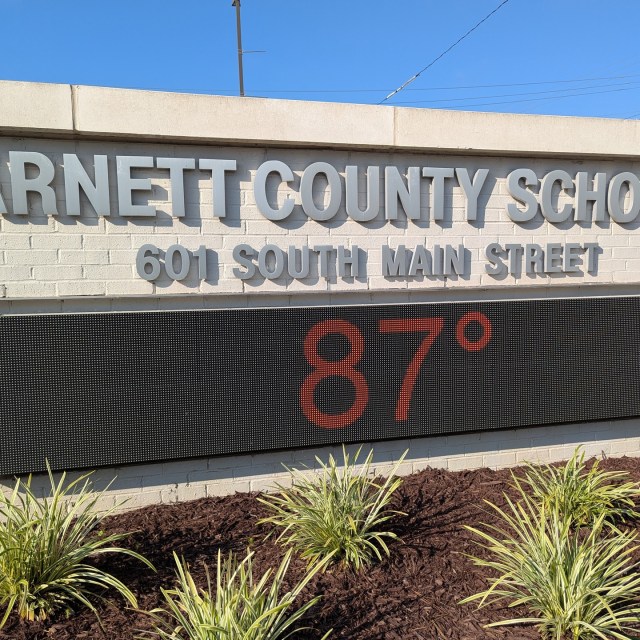
Mara: Harnett County’s budget teeters on property tax bill shows similar strain — a proposed $215.1 million budget with a $7.7 million gap between what schools requested and what the county can fund, while commissioners debated nonprofit cuts and a newly approved chatbot service.
Pip: And the week’s news digest notes Moore County’s proposed $239 million budget actually cuts the general fund tax rate slightly, leaning on tourism revenue and rising property valuations to hold the line.
Mara: All three counties are watching House Bill 1089, which would cap local property tax levy growth. Harnett’s chairman warned the budget “could be under different rules in a couple of weeks.” Moore’s commissioner chair, Nick Picerno, defended the cap directly, saying “restricting property tax rate increases forces government entities to manage their budgets carefully and not rely on a never ending stream of revenue from the public property tax.”
Pip: That’s the whole debate in one sentence — and voters may get to weigh in on it in November. Which connects directly to what’s happening on the ground with housing.
Pip: Growth is the pressure behind every budget fight we just heard, and the housing and development decisions happening right now will shape those budgets for years.
Mara: Governor Stein’s executive order sets the statewide frame. He signed it May 19, saying “Too many families are struggling to make rent or afford a home. This executive order directs a whole-of-government approach to get more homes of all types built and make homeownership more accessible and affordable for North Carolinians.” North Carolina faces a gap of more than 750,000 housing units through 2029.
Pip: More supply sounds straightforward until you read what’s happening in Sanford, where a 473-home mixed-use project called Oakton got tabled because the council wants renderings showing how it looks from the highway — and because it feeds into schools already nearing capacity.
Mara: The Sanford piece also covers the Broadwell Conditional Zoning District update, adding townhomes and single-family homes in the Jonesboro district, and a Landmark Towing rezoning of countryside land to light industrial use — a move the reporting flags as a pattern that gradually erases rural character. Both go back to the council for a vote next meeting.
Pip: More homes, tighter schools, rural land quietly rezoned — that tension runs straight into what the graduation stages this week were full of.
Mara: Sandhills Community College’s commencement on May 16 put 508 graduates on the McNeill-Woodward Green. Keynote speaker and SCC alumna Kayla Renee Lowery, who opened her own bakery at 23, kept her advice short: “You don’t have to start big. Just start.”
Pip: That’s the kind of line that earns its applause. And the numbers behind it matter — 915 total graduation applications, with Sandhoke Early College alone contributing 73 associate degrees.
Mara: Central Carolina Community College’s commencement, its 68th, celebrated 663 spring graduates across three ceremonies in Lee, Harnett, and Chatham counties. CCCC President Dr. Lisa Chapman told graduates they carry “the strength of this place and the belief that we all have in you.” Student speakers ranged from a veteran starting a nonprofit to a mother returning after more than 20 years of homeschooling her children.
Pip: Two campuses, hundreds of graduates, and the same message underneath: persistence pays. That spirit of community recognition carried into Sanford’s city hall this week too.
Mara: At the May 19 Sanford City Council meeting, Dr. Charles Alexander arrived thinking he was there to carry a proclamation to Raleigh on behalf of older citizens. Instead, Mayor Rebecca Salmon handed him one. “I thought I was here to take a proclamation to Raleigh,” Alexander said. “It was a surprise.” The honor recognized 32 years of public education, senior enrichment work, and Kiwanis membership.
Pip: Thirty-two years of service, and he still showed up thinking he was doing someone else a favor.
Mara: Also this week, a guest editorial from Robert Levy takes on a much larger stage — arguing that both the Biden and Trump administrations have quietly moved toward accepting China’s eventual absorption of Taiwan, prioritizing domestic chip production over military commitment to the island’s independence.
Pip: Local government, graduation stages, and geopolitics — not a bad week’s range.
Mara: Budgets, school capacity, housing supply, and what communities choose to honor — it’s all connected to the same underlying question of how fast a place can grow before it outpaces what it can sustain.
Pip: Next episode, we’ll see whether any of those June budget hearings produced answers. Or at least better questions.
Read the week’s details in News Lines May 16-22 in Moore Lee & Harnett.
May 22, 2026
Subscribe to Sandhills News and support this conservative flagship journalism with advertising.
Submit news tips, events and interview requests to editor@sandhills.news.
Sandhills News is plain-English local government reporting that explains how decisions affect your land, taxes, schools and rights.


Subscribe to get the latest posts sent to your email.









 Sylvan Learning of Southern Pines NC is the investment you make for your child's sake. Education. https://sandhills.news/2025/12/07/sylvan-learning-of-southern-pines/5 months ago

 You can also follow on Instagram to see more.
Follow Sandhills News on Facebook and Instagram to learn the latest in Moore, Lee and Harnett.
We cover family-friendly news.6 months ago
Sandhills News will cover Five Points Horse Trials – Treehouse Event Series Championships today!
Carolina Horse Park, 2814, Montrose Road, Raeford, NC
Carolina Horse Park serves cross country, dressage, jumping and classes with a side of green biscuits from Sept. 5 through Sept. 7.
Love horses? This is where you can enjoy the show and the ambiance equestrians recognize as energy in the air when eventers pass by and revel in their accomplishments and neighs sound another moment of glory—unless they lose. In which case, barn language ensues.
Read the full schedule, plan your days and enjoy! Carolina Horse Park schedule for Sept. 5-7.
Food trucks will be on-site.9 months ago
Moore County Commissioners approve infrastructure upgrades in Pinehurst after Tropical Storm Chantal closed 13 roads and busted a dam in other towns in Moore County. https://sandhills.news/2025/07/16/moore-county-eyes-flooding-solutions-and-approves-1-2m-for-school-turf-projects-as-schools-face-budgets-cuts/10 months ago
Moore, Lee, and Harnett NC opioid settlement funds did not consider residential treatment for women. https://sandhills.news/2025/07/13/sandhills-opioid-funding-misses-the-mark-for-residential-treatment/10 months ago
You can also follow on Instagram to see more.
Follow Sandhills News on Facebook and Instagram to learn the latest in Moore, Lee and Harnett.
We cover family-friendly news.6 months ago
Sandhills News will cover Five Points Horse Trials – Treehouse Event Series Championships today!
Carolina Horse Park, 2814, Montrose Road, Raeford, NC
Carolina Horse Park serves cross country, dressage, jumping and classes with a side of green biscuits from Sept. 5 through Sept. 7.
Love horses? This is where you can enjoy the show and the ambiance equestrians recognize as energy in the air when eventers pass by and revel in their accomplishments and neighs sound another moment of glory—unless they lose. In which case, barn language ensues.
Read the full schedule, plan your days and enjoy! Carolina Horse Park schedule for Sept. 5-7.
Food trucks will be on-site.9 months ago
Moore County Commissioners approve infrastructure upgrades in Pinehurst after Tropical Storm Chantal closed 13 roads and busted a dam in other towns in Moore County. https://sandhills.news/2025/07/16/moore-county-eyes-flooding-solutions-and-approves-1-2m-for-school-turf-projects-as-schools-face-budgets-cuts/10 months ago
Moore, Lee, and Harnett NC opioid settlement funds did not consider residential treatment for women. https://sandhills.news/2025/07/13/sandhills-opioid-funding-misses-the-mark-for-residential-treatment/10 months ago Harnett County Schools seek community support for student service-learning projects.
https://sandhills.news/2025/07/12/harnett-schools-service-learning-program-invites-community-support/10 months ago
Harnett County Schools seek community support for student service-learning projects.
https://sandhills.news/2025/07/12/harnett-schools-service-learning-program-invites-community-support/10 months ago Angier is home to the Corner Grill and locals who know where to find HOMEMADE food!
https://sandhills.news/2025/07/12/locals-crave-the-corner-grills-chicken-salad-sandwich-and-cheesburgers/10 months ago
Angier is home to the Corner Grill and locals who know where to find HOMEMADE food!
https://sandhills.news/2025/07/12/locals-crave-the-corner-grills-chicken-salad-sandwich-and-cheesburgers/10 months ago Fred Lee IV wows the crowd at Kiwanis Park in Sanford, NC.
Book him for your next event.
https://sandhills.news/2025/07/14/fred-lee-iv-wins-the-crowd-at-kiwanis-park/10 months ago
Sandhills News loved the bagpipes in the 4 July 2025 Village of Pinehurst Parade!
See all the photos.
https://sandhills.news/2025/07/05/moore-pinehurst-and-whispering-pines-parades-highlight-community-spirit/11 months ago
Fred Lee IV wows the crowd at Kiwanis Park in Sanford, NC.
Book him for your next event.
https://sandhills.news/2025/07/14/fred-lee-iv-wins-the-crowd-at-kiwanis-park/10 months ago
Sandhills News loved the bagpipes in the 4 July 2025 Village of Pinehurst Parade!
See all the photos.
https://sandhills.news/2025/07/05/moore-pinehurst-and-whispering-pines-parades-highlight-community-spirit/11 months ago


